
 Posted by
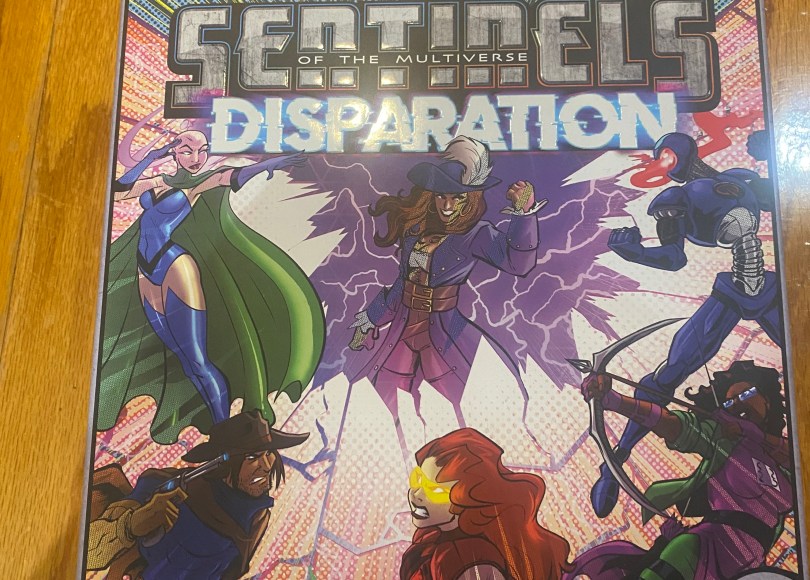
 During my time in college, one of my friends introduced me to Sentinels of the Multiverse: Definitive Edition. It was a cooperative boss battler where you play as a team of heroes facing off against a powerful villain. We played A LOT of the base game over our last few months as students. I enjoyed the game so much that I quickly picked up my own copy shortly after graduation. Within a few months, I got the Rook City Renegades expansion at Christmas time. Back in 2023, the next expansion, Disparation, was unveiled and crowdfunded. Unfortunately, the story for Disparation wasn’t nearly as smooth as its predecessors. Due to health issues on the part of one of the creators and the ambitious nature of this expansion, it took longer to put together than the others. Then right as the expansion was finished up and ready to be printed, the tariffs hit. The game was further delayed, the company behind the game was shuttered by its parent company, and Disparation was thrust back into limbo. Back in February, the expansion was finally released and I immediately placed an order for it. As it stands right now, Disparation is not really available anywhere right now, so I’m really happy I was able to snag a copy when I did. The unfun truth is that the future of the game is kind of murky right now, but one of the creators remains optimistic, so here’s hoping that the game receives its last three expansions. Now onto my review of Disparation.
This review is not going to be comprehensive. Disparation includes a very respectable amount of content: six heroes, nine villains and their respective events and critical event variants for a total of eighteen new fights, five environments, variants for existing heroes in the base game, and the new Principles deck. It’s a lot of content, and I haven’t come close to experiencing all of it. As a result, this review is largely going to cover my first impressions and experiences with what I’ve seen.
The new heroes include Chrono-Ranger, K.N.Y.F.E., The Visionary, Omnitron-X, Parse, and Darkstrife and Painstake. Of these six, I’ve personally played four of them, and I have seen the other two played. Chrono-Ranger is a bounty hunter who specializes in a mix of damage and utility. His signature mechanic is placing bounty cards next to targets that incentivize taking them down and reward Chrono-Ranger for doing so. He’s decent, but I honestly expected a little more from him sometimes. For a bounty hunter, his damage seems a little hampered at times in favor of debuffing utility. He’s fine for the most part, I probably just need to learn how to optimally play him. K.N.Y.F.E. is a very simply damage dealer who also specializes in taking down targets and is rewarded for doing so. Her playstyle is pretty simple, but that’s not a bad thing. She hits things, and she does it well. I’ve had a good time with her. The Visionary is a support character who mostly focuses on deck manipulation. She’s good at looking at the top cards of decks to see what comes next. I don’t like her very much or find her very useful. I used her for a few fights, and she felt pretty dead in the water most times. Part of the issue may be that she is best suited as the fourth or fifth hero in a team, and not one of three; when there are three heroes, each one really needs to pull its own weight, so having deck manipulation support doesn’t do that much, especially when so many villains (the targets you’re going to be deck manipulating the most) have ways to play multiple villain cards, so seeing the top card of the villain deck might not actually do that much. Maybe I’ll like her as I use her more, but as it stands, she’s kind of mid. She does have a cool little Dark Side Deck that features (supposedly) powerful cards that can come out unpredictably; it’s a cool mechanic that is well implemented, even if the character feels underwhelming. Omnitron-X is fun. It’s a robot that’s also the hero variant of a villain you fight in the base game. I’m a big fan of hero variants of villains, so it’s really cool having another one. Omnitron-X is a lot like its villain counterpart where it wants to build up items, then activate the unique Fabricate or Exterminate functions on them. Omnitron-X is capable of some really cool combos, and is probably one of my favorite new additions. I have not personally played Parse, but I’ve seen her in use. She seems quite good. She’s another hero that leans more into support, this time specializing in card draw. That being said, she’s pretty good at dealing damage and can enable some insane combos, like doubling a single instance of damage dealt by a hero (which means my beloved Bunker could hypothetically drop an Omni-Cannon attack for 100+ damage, which is absolutely insane). Parse is a great addition, and I look forward to seeing more of her. Darkstrike and Painstake is the first double hero released. They’re two individual hero cards with their own health totals, but they share a deck and hero play area. They’re complex, but capable of some ridiculous combo potential as a result. After seeing them in action, I would love to try them out because they can output some ridiculous damage. Each hero comes with four character cards you can use, which leads to some really nice variety.
The new villains include Apostate, Grimm, The Dreamer, Necrosis, La Capitan, Miss Information, The Ennead, The Ruler of Æternus, and Iron Legacy. Each villain has a base fight, an event that can modify the fight, and a critical event variant. It’s a lot of content to fight and battle through. I have experienced a fraction of it. So far, I’ve only fought Apostate, Grimm, The Dreamer, Necrosis, and La Capitan, and I beat all of them except La Capitan. And even at that, this was just the base variant of each. Apostate and Grimm are technically the two easiest fights in the game, but that’s kind of not true. Apostate has two distinct phases. In his first phase, he likes to throw out special Lie cards that debuff heroes and present challenges. Once the conditions are fulfilled, the Lie card is resolved, and once enough of them are resolved, Apostate’s character card will flip and he’ll enter phase two, which is a much more straightforward fight. All the while he’s throwing out Relics and Demon minions. It can be a lot to juggle, and it can add up quickly. The other “easy” fight is Grimm. He’s a storyteller who likes assigning everyone Roles, and if you Perform your Role too much, everyone loses. There are ways to counteract it of course, but it can be a slog of a fight, especially because he’s very tanky. He doesn’t throw out any minions at you which is nice, and he really doesn’t deal much damage. The biggest threat he poses comes from his alternate loss conditions that build up as you Perform Role actions. You can sometimes Resist, so the key to victory comes in balancing when to Perform and when to Resist, and keeping Grimm on the right character side. The Dreamer is a really different fight because she’s not a boss; she’s a very weak target you need to protect from Nightmare targets that come out of the villain deck. Once you destroy enough of them, you win. This is another fight with two very distinct phases. Each phase is very similar with there being a Nightmare target requirement, but they are distinct phases. Necrosis is rough. He’s capable of spamming minion targets that can really rack up damage quickly on you. In addition, he likes to inflict tokens on you that he can then use to deal obscene amounts of damage. He’s not rated as particularly difficult, but he ended up being quite brutal when we fought him. La Capitan is a time traveling pirate who likes to steal your stuff. She throws her crew at you and takes your cards, and if she has enough, she becomes a lot harder to damage. I haven’t beaten her yet, but I think part of that was due to not having the best team composition. Team composition really matters because it can make harder fights manageable, and easy fights impossible. While I haven’t done the other four fights yet, they look interesting. Miss Information is another two phase fight that looks to be rather debuff and target heavy. The Ennead interests me because the fight consists of nine enemy Egyptian gods, though you aren’t fighting them all at once, or even all of them during a given battle. I need to see how they work, but it looks like if there are no targets left, you win, so hope you don’t get overwhelmed I guess. The Ruler of Æternus looks similar where it’s a target rich fight involving Demon Princes duking it out over a throne. Once all the Princes are defeated, you win. But of course if a Prince has the throne, it’s a lot scarier, and harder, to deal with. These two fights look the most intriguing to me, and I’m really excited to try them out. Finally, there’s Iron Legacy. He’s the hero Legacy going through his Injustice Superman arc. Basically, it’s the villain counterpart of a beloved hero, and he sounds ROUGH: high damage, lots of debilitating debuffs, heals himself, and so on.
The new environments include Silver Gulch, 1883, The Tomb of Anubis, Æternus, The Block, and The Final Wasteland. I’ve played in three of these environments. Silver Gulch is probably my favorite because of how it has a mix of helpful cards, and hazards. The hazards usually end up helping out a bit more since they like to ping everything for damage, or the healthiest targets, which almost always includes the villain. The Tomb of Anubis is very similar, but probably a harder just in terms of damage. Æternus is very similar too, but this one can synergize with the Ruler fight, making it more unique and dynamic, and dangerous. I don’t know much about the other two environments.
Lastly, this expansion adds in the Principle deck, which includes cards that can completely change how heroes play. I have yet to use any, but they look cool because of how they can add more variety to gameplay. I’ll never say no to more content, especially when it doesn’t actually change the pricing of the expansion. And of course the expansion also adds in new character variants for heroes in the base game, so now every hero has at most four versions, and at least three. Again, more content and replayability is always welcome.
Lastly, I want to talk about difficulty and powercreep. I feel like Disparation has added in a new level of both. Necrosis is a difficulty four (out of ten), yet he’s spawning minions at rates that Matriarch and Grand Warlord Voss (difficulty seven and eight fights respectively from the base game) would approve of while also dealing damage that’s taking our tankiest hero down to half health within one or two turns. Sure, there’s some luck involved in the fight, but holy crap that’s brutal. None of the fights so far have felt like the advertised difficulty (except maybe Grimm now that I look at him with hindsight), but like they got bumped down two from where they should be. That being said, a lot of it could still be a mix of learning the decks and bringing the right heroes for the job. Using Matriarch as an example again, she’s rated difficulty seven, but I know how to trivialize her by bringing two heroes that completely shut down her board. However, the heroes also seem to have gotten some powercreep. In the base game, having cards that you could combo to increase your action economy was huge, and kind of rare. The name of the game is action economy; if you are able to play multiple cards or use multiple powers or draw more cards, that will be better than not every single time. Basically every Disparation hero is capable of chaining plays, draws, or powers to significantly increase their action economy and options. On the one hand, I’m not complaining. It’s fun to combo or enable other people to combo. But it also makes some heroes clearly stronger than others. I’ll need to play around more with the expansion and all of its content before my opinions can solidify, but I have enjoyed my time with the game so far, even if its difficulty can feel pretty tough at times.
Sentinels of the Multiverse is probably my favorite board game. I’m really happy that the Disparation expansion finally released, and I’ve been really enjoying it so far. I’m hoping that this isn’t the last release of Sentinels content we’ll get, but we’ll just have to wait and see. It’s a really fun game that blends cooperative teamwork with engaging boss battles, all in a really cool comic book superhero aesthetic with a richly developed world and lore. If you like board games or card games, give Sentinels a try, and keep an eye out for copies of Disparation.
Make a one-time donation
Make a monthly donation
Make a yearly donation
Choose an amount
Or enter a custom amount
If you enjoy my content, consider making a donation. I would greatly appreciate any and all support, and it would go a long way towards helping me fund future content.
Your contribution is appreciated.
Your contribution is appreciated.
DonateDonate monthlyDonate yearly Broad Scope Entertainment